'The speed at which an aircraft lands or takes off, even a single object can work as a bullet.'

The Supreme Court of India has directed the governments of Punjab and Haryana to cooperate with the Centre in finding an amicable solution to the long-standing dispute over the Sutlej-Yamuna Link (SYL) canal. The court deemed the de-notification of land acquired for the canal in Punjab an "act of high-handedness" and emphasized the need to consider "wider ramifications" beyond legal considerations. The court has set August 13 for a further hearing if an amicable solution is not reached.
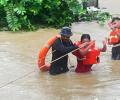
The rain and flood situation in northeastern states remained grim on Tuesday, with lakhs people affected in Assam, Mizoram and Manipur, even as the meteorological department predicted more rain in several parts of the region.

Prime Minister Narendra Modi asserted on Tuesday that India's water will no longer flow outside the country but will be utilized in the nation's interest, a statement seemingly directed at Pakistan following his government's decision to put the Indus Waters Treaty in abeyance after the Pahalgam terror attack. Addressing the ABP Network's 'India@2047' Summit, Modi emphasized his government's focus on interlinking rivers, noting that water used to be a source of conflict among states, before alluding to India's stance against Pakistan while discussing water. He highlighted the finalization of the India-UK free trade agreement as a historic milestone and underscored the importance of prioritizing national interest for achieving objectives and realizing the country's potential. Modi highlighted the country's growth and development under his government's rule, emphasizing its focus on welfare schemes and digitalization. He reiterated his government's commitment to 'Nation First' and pointed to the recent reforms undertaken, including the new Waqf law and the ban on triple talaq, which he said were aimed at benefiting the marginalized sections of society.
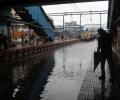
Maharashtra Deputy Chief Minister Eknath Shinde on Monday attributed early arrival of the southwest monsoon and heavy rainfall in a short span for the inundation of low-lying areas in Mumbai, which disrupted road and railway traffic.
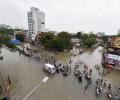
In signs of easing of situation, the water levels of Adyar and Kumbh rivers have fallen considerably following reduced discharge from reservoirs on Thursday night.

The EC asked him to provide factual evidence with specific and pointed response to type, quantity, nature and manner of poisoning of Yamuna.

MV Ganga Vilas will begin its journey from Varanasi and sail around 3,200 km in 51 days to reach Dibrugarh in Assam via Bangladesh, traversing across 27 river systems in the two countries, it said.

Pakistan troops have violated the ceasefire agreement for the 11th consecutive night, firing on Indian posts along the Line of Control (LoC) in Jammu and Kashmir. The firing began in Kupwara and Baramulla districts and spread to other sectors, including Poonch, Rajouri, Mendhar, Naushera, Sunderbani, and Akhnoor. The Indian Army responded promptly and proportionately. The ceasefire violation comes despite a recent phone call between the Directors General of Military Operations (DGMOs) of India and Pakistan on April 29. This marks the latest escalation of tensions between the two countries, following a terror attack in Pahalgam in April.

President Droupadi Murmu's address to the nation on the eve of the 79th Independence Day.
'The government has to explain (to the army, air force and navy chiefs) whether they want a punitive strike, a deep punitive strike, or whether they want limited war or an all-out war, will it be a circumscribed war or will it be a shallow attack along the border.'

In view of the safety of the passengers, the district administration stopped the passengers at Sonprayag and Gaurikund due to continuous bad weather.
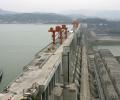
China has approved the construction of the world's largest dam on the Brahmaputra River in Tibet, close to the Indian border. The USD 137 billion project, which is expected to dwarf even China's own Three Gorges Dam, has raised concerns in India and Bangladesh, the downstream riparian states. Concerns in India are centered around China's potential to control water flow, potentially enabling the release of large amounts of water to flood border areas in times of hostilities. The dam is part of China's 14th Five-Year Plan, and the Chinese government claims that the project is safe and prioritizes ecological protection.

Since Tibet's occupation, China has disrupted the natural flow of rivers by pursuing a series of ill-conceived environmental and developmental policies such as the Great Leap Forward, the South-North Water Diversion Project, etc, the report said, adding that, this has led to a dam-building spree on the Tibetan plateau with disastrous impacts on Asia's major rivers.

Andhra Pradesh Chief Minister N Chandrababu Naidu and his Telangana counterpart Revanth Reddy visited some inundated areas in their respective territories.

Coimbatore-based environmental activist R Manikandan, was named the South Zone Water Warrior by the Government of India's Jal Shakti ministry.
Union Home Minister Amit Shah said on Sunday that indigenously developed BrahMos missiles destroyed Pakistani air bases while its air defence system, borrowed from China, remained unused, during Operation Sindoor, which exposed its lies on terrorism to the world.

Australia's third largest metropolis, Brisbane, turned into a city under siege as swelling muddy waters submerged major parts of the town, swallowed roads and the entire river front in the worst ever flooding which hit 30,000 properties.

The four students -- two boys and two girls aged 18-20 -- were studying at the nearby Novgorod State University in Veliky Novgorod city.

According to the EIC, Telangana officials are allegedly not allowing Andhra Pradesh officials to even enter the dam to conduct inspections.

For the ninth consecutive night, Indian and Pakistani troops engaged in small arms fire along the Line of Control (LoC) in Jammu and Kashmir, continuing a pattern of heightened border tensions. The skirmishes, initiated by Pakistani troops in violation of the ceasefire agreement, have led to a tense situation along the LoC and International Border (IB). The incidents come in the wake of the April 22 terror attack in Pahalgam, which claimed the lives of 26 people, mostly tourists. Civilians residing near the border have begun preparing their bunkers, anticipating potential escalation. Despite a recent hotline conversation between the Directors General of Military Operations (DGMOs) of India and Pakistan, where India cautioned Pakistan, the ceasefire violations persist.

China plans to divert about 200 billion cubic metres of water annually from the Brahmaputra at its highest point, namely the Great Bend, where it turns into India. China's Brahmaputra dam will severely impact India, warns former senior RA&W officer and China expert Jayadeva Ranade.

Three ICU patients were among those being shifted from the Sushruta Trauma Centre located opposite Chandiram Akhada in north Delhi, a senior official said.

The Supreme Court of India has dismissed a petition filed by an NGO challenging the construction of a renewable energy project at the Jayakwadi Dam in Maharashtra. The court criticized the NGO for opposing the project, stating that it would be detrimental to the country's progress if every project was resisted. The court also raised questions about the NGO's bona fides and funding, suggesting that it may have been influenced by a company that lost the tender for the project. The project, a floating solar power plant, was approved by the National Green Tribunal (NGT) and the Ministry of Environment, Forests and Climate Change. The NGT had previously dismissed the NGO's plea, stating that it could not find any law prohibiting such activities in the eco-sensitive zone. The Supreme Court upheld the NGT's decision, finding no grounds to interfere.
China has defended its plan to build the world's largest dam on the Brahmaputra River in Tibet, assuring that the project will not affect riparian states and safety issues have been addressed through decades of studies. The dam, estimated to cost USD 137 billion, has raised concerns in India and Bangladesh, but Chinese authorities maintain that the project has been thoroughly studied and safeguards are in place. The dam is part of China's efforts to develop clean energy and respond to climate change.

Every river is a living person, argues Gopal Krishna on the basis of the recent Uttarakhand HC verdict.
China has reiterated its plan to build the world's largest dam over the Brahmaputra River in Tibet, near the Indian border. The Chinese Foreign Ministry has assured that the project, estimated to cost around USD 137 billion, will not have any negative impact on downstream countries, India and Bangladesh. The ministry has stated that the project has undergone rigorous scientific verification and will be conducive to disaster prevention and mitigation, as well as climate change response. India has expressed concerns about the dam, raising the issue during talks with the visiting US National Security Advisor, Jake Sullivan. China has maintained that the project will not negatively affect the lower reaches and has committed to maintaining communication with downstream countries.

Pakistan today pressed India to release its share of river waters under the Indus treaty as it has documentary evidence that its due share of water had been "stolen" from the Chenab river.

Delhi Bharatiya Janata Party chief Virendra Sachdeva was admitted to the RML Nursing Home on Saturday with complaints of itching and breathing difficulties, two days after he took a dip in the heavily-polluted Yamuna to highlight the alleged failure of the Aam Aadmi Party government to clean the river.

A three-judge bench headed by Justice BR Gavai sought a report from the Cauvery Water Management Authority on the amount of water released by Karnataka, after additional Solicitor General Aishwarya Bhati informed the court that a meeting of the authority is scheduled for Monday.
"Our existing institutional arrangements for managing inter-state rivers seem to have broken down. Unless we create effective institutional arrangements, sharing of river waters is likely to become a source of internal conflict."
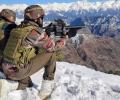
Pakistan's troops have engaged in unprovoked firing along the Line of Control (LoC) and International Border (IB) in five districts of Jammu and Kashmir, prompting retaliation from the Indian Army. This marks the eighth consecutive night of such incidents, following heightened tensions stemming from a recent terror attack in Pahalgam. Civilians residing along the LoC and IB are preparing their bunkers in anticipation of potential escalation.
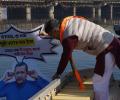
Kejriwal claimed he would clean the river by 2025, but the situation has worsened. "By immersing his effigy, we are exposing his failure to the people of Delhi, he said.

Jorhat has many attraction to offer for the discerning and offbeat traveller.

The rhythmic sound of the oars hitting the water and the sight of countless pilgrims chanting along the riverbanks created an unforgettable atmosphere, says Varalaxmi Sompuri.
Pakistani authorities have a tendency to "pass the buck" and exaggerate differences with India over the sharing of river waters though mismanagement within the country is resulting in the loss of 34 million acre feet of water, Pakistan Foreign Minister Shah Mahmood Quereshi said on Friday.
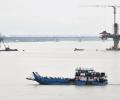
India has expressed concerns over China's plan to build a mega dam on the Brahmaputra River in Tibet, stating that it will continue to monitor and take necessary measures to protect its interests. New Delhi has urged Beijing to ensure that the interests of downstream states are not harmed by activities in upstream areas. The dam, estimated to cost USD 137 billion, has raised apprehensions about its impact on the ecological balance of Arunachal Pradesh and Assam, through which the Brahmaputra flows. India has repeatedly expressed its concerns to China through diplomatic channels, highlighting the need for transparency and consultation with downstream countries.

Aam Aadmi Party chief Arvind Kejriwal on Wednesday responded to the Election Commission notice over his claim the Haryana government was 'mixing poison' in Yamuna, and said raw water received from the Bharatiya Janata Party-ruled state in the recent past has been 'highly contaminated and extremely poisonous' for human health.

Undeterred by the attack, Munde said it was out of 'contentment' of seeing water in the trench due to the desliting work that she took selfies.

'Why should the people of Odisha divert water from the Mahanadhi when 13 out of 32 districts are chronically drought prone?' 'Water is a state subject. Can you really nationalise rivers for which you need drastic amendments in the Constitution?'
